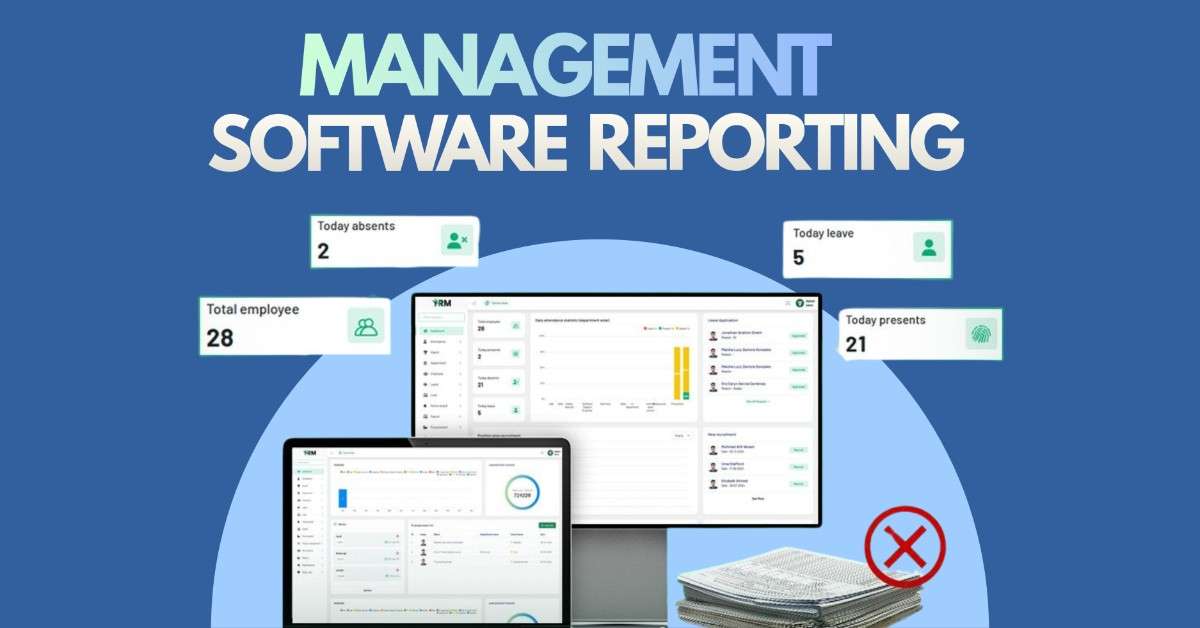
In today's global business environment, businesses are under increasing pressure to become and remain competitive, productive, and profitable. No matter if your business is in India, the United States, Europe, Africa, the Middle East, Australia, or Southeast Asia, the demand for accurate reporting in real time has become a standard. Worldwide, leaders are asking for quicker insights, sharper visibility, and deeper data intelligence.
It is because of this that management reporting software has become one of the most critical tools in modern organizations, acting like the central nerve system to connect data from various departments into dashboards and reports that help teams make informed decisions.
Imagine a powerful digital assistant collecting all your business data, ranging from finance, sales, and marketing to operations, HR, assets, and logistics, and turning it into meaningful insights. That is exactly what management reporting software does.
Instead of spending hours combining Excel sheets, organizing numbers, and preparing reports by hand, the software:
Automatically pulls data from different systems
Shows everything in clean dashboards
Sends regular reports
Maintains performance indicator records
Supports real-time notifications
Helps leaders make confident decisions
It is a single platform that brings clarity across the organization, whether you are running a local business or a global enterprise.
The world is moving fast, markets are changing faster, and competition is getting stronger. This implies that decisions must be made on time and supported with valid data.
Here are the global reasons that drive the adoption of management reporting software:
Businesses cannot afford to depend on manually created monthly or weekly reports. Automation speeds up decision-making.
Companies in every region struggle with scattered data. This software brings everything together.
Whether your team is in Dubai, Delhi, London, or New York, they should see the same updated numbers.
What modern leadership seeks is real-time visibility into performance, revenue, operations, and risks.
Traditional reporting simply won't work with distributed teams anymore.
These challenges have created the global necessity for management reporting software.
Whether your business operates in one country or across multiple regions, the core features of this software remain extremely valuable. Let's break them down.
A unified dashboard brings together data from:
Finance
Operations
HR
Inventory
Production
Sales
Assets
Customer service
It gives leaders one clear picture of what's happening.
Businesses all over the world waste hours every week preparing reports. Automation changes that by generating daily, weekly, monthly, and annual reports without manual effort.
Different industries track different metrics. This software enables you to build KPIs that reflect your business model and global operations.
This system provides alerts right away when something has gone wrong, like high unforeseen expenses, low inventories, equipment breakdowns, or a drop in sales.
The best management reporting software integrates with:
ERP systems
CRM platforms
HRMS tools
Inventory systems
Accounting platforms
IoT devices
Manufacturing equipment
E-commerce tools
This makes data flow across global locations frictionless.
Every business attracts to visual clarity. Dashboards use
Bar charts
Pie charts
Scorecards
Heat maps
Trend lines
Forecasting models
These help a manager grasp performance issues in a short amount of time.
As organizations in various countries have several departments, role-based access ensures that each group sees only the data it needs.

Let's explore how businesses across continents use this tool every day.
Manufacturing companies rely heavily on real-time insights. They utilize management reporting software to:
Track machine performance
Identify downtime
Monitor production cycles
Reduce wastage
Improve quality control
Compare plant performance across regions
Retail & E-Commerce
Retailers all over the world use this software to:
Track daily sales
Inventory monitoring
View customer behavior
Improve order fulfillment
Identify top performing stores
Timing is everything for logistics companies. They use reporting tools to:
Monitor delivery performance
Optimize routes
Fuel consumption analysis
Track fleet efficiency
Reduce delays
Reporting systems are in place for various purposes in many hospitals and clinics around the world. The purposes include:
Improve patient flow
Track staff availability
Manage resources
Comply with
Hospitality
Hotels and resorts use reporting dashboards to:
Track occupancy
Manage seasonal trends
Enhance guest experience
Revenue per booking analysis
Construction companies use it to:
Monitor project timelines.
Track material usage
Control costs
Improve contractor performance
Finance & Insurance
Banks and insurance firms rely on reporting software for the following:
Compliance tracking
Claim management
Risk analysis
Tracking of revenue
The software brings structure, clarity, and accuracy across all industries.
Businesses operating across countries face several challenges, such as:
Currency differences
Region-specific regulations
Multi-location coordination
Data scattered across systems
Different operating procedures
Time zone differences
Management reporting software solves all these through centralization and standardization of the process. It gives every department—from every region—the same up-to-date numbers.
The company has factories in India, Malaysia, and Germany, and it uses the dashboards to compare downtime and production performance across all plants.
A fashion brand monitors how different stores perform on different continents and determines which regions are outperforming others.
They track delivery delays across various countries and optimize their shipping network.
Management is comparing in real-time the occupancy rates of Dubai, Singapore, and London.
Tracks renewal rates, churn, and customer health scores across global users.
These examples show just how valuable management reporting software becomes for large-scale operations.
Reporting time is considerably reduced, in some cases by 50% or more.
Automatic data eliminates all guesswork and human errors.
Everybody knows his or her key performance indicators and performance expectations.
With real-time notifications, unnecessary spending is instantly pinpointed.
Teams across different countries work on the same data.
No delays, no confusion-just clarity.
It connects to BI tools, dashboards, reporting systems, and automation.
Companies that search this keyword are usually ready to compare solutions.
A strategic usage of the keyword in blogs, headings, and metadata helps businesses rank in global markets.
Here's what organizations all over the world consider when choosing a reporting solution:
Must integrate with all your key systems.
Perfect for companies with multi-country operations.
Should support growth from 10 to 10,000 users.
Look out for encryption, ISO certifications, secure access controls.
Should support region-specific reporting.
Teams should adapt easily.
More automation = better global efficiency.
Future of Management Reporting Software: A Global Outlook
The next-generation reporting tools will be powered by:
AI
Predictive analytics
Machine learning
Natural language reporting
Industry-specific insights
Automated forecasting
Real-time anomaly detection
IoT data integration
Those companies that adopt these solutions early will continue to lead in their respective businesses.
Whether your company is in the U.S., India, UAE, Europe, Africa, or anywhere in the world, the need remains the same: clear visibility into performance and instant access to actionable insights.
Management reporting software provides businesses with:
Speed
Accuracy
Transparency
Automation
Predictive intelligence Better decision-making Stronger performance Higher profitability In a world driven by data, this software isn't just helpful-it's essential.
.png)
Got a question? We’ve got answers. If you have any other questions, please contact us via our support center.
.webp)

.jpeg)
